

Vehicle electrification is a cornerstone of California’s decarbonization strategy, yet how and when EVs charge will determine their ultimate impact on the grid. This study, conducted by Evolved Energy Research (EER) in partnership with the Union of Concerned Scientists (UCS), assesses how different scales of VGI deployment can optimize system-wide savings and mitigate infrastructure costs in the long run. By leveraging EER’s advanced modeling capabilities, this research illustrates how two different forms of VGI, smart charging (V1G) and bidirectional charging (V2G), influence grid reliability and cost efficiency through 2045.
Methods
EER employed its Regional Investment Optimization (RIO) model to simulate California’s least-cost decarbonization pathway while integrating light-duty EV charging as a flexible resource. The analysis accounted for variations in EV participation in V1G and V2G, assessing their impact on electricity generation, transmission, and distribution costs. EER’s approach incorporates constrained optimization techniques to evaluate charging behavior across different feeder types, providing a more granular understanding of grid interactions and avoided investments.
Results
- V2G Delivers the Greatest System Savings
- Assuming 50% of eligible light-duty vehicles participate, VGI can reduce California’s total energy system costs by $4–$11 billion annually by 2045.
- By avoiding more infrastructure and operation costs, V2G yields deeper savings than V1G alone.
Figure 1. Savings Across a Range of Vehicle-Grid-Integration Scenarios (2045)

Note: This figure presents total system savings, savings as a share of total energy system costs (right-hand axis), and per-vehicle savings. Optimized charging alone can yield approximately $500 in annual system benefits per participating EV, while V2G increases this value to just under $1200 per year.
- Avoided Infrastructure Investments Drive Savings
- VGI lowers electricity delivery costs by reducing peak demand at the feeder level.
- The flexibility from optimal charging displaces the need for battery storage along with some thermal capacity.
Figure 2. Savings by Category Across 50% VGI Scenarios (2045)
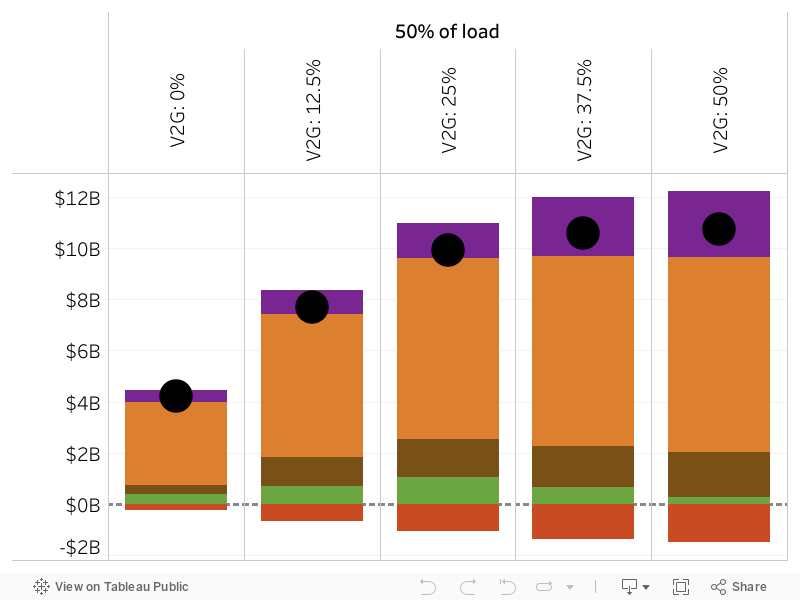
Note: This figure illustrates how savings increase as higher levels of V2G participation enable more avoided distribution and capacity costs.
- V2G Operations Prioritize Reliability Over Daily Shifting
- V2G discharge is used infrequently, primarily during key reliability periods rather than for daily load shifting.
- Charging and discharging behavior varies significantly from day to day, providing targeted support when the grid needs it most.
Figure 3. Strategic Use of V2G Discharge During Reliability Events (2045)

Note: This figure illustrates how hourly charging patterns respond to grid conditions daily and how limited, strategic V2G discharge supports system reliability without overburdening vehicle batteries. The grey area represents the charge and discharge envelope for vehicles; the black line represents average daily behavior; and the blue lines represent behavior on modeled days.
Discussion
The results underscore the transformative role of VGI in California’s energy transition, highlighting the need for strategic policies and incentives to accelerate V2G adoption. V2G’s value lies not in daily cycling but in its ability to provide targeted support during critical grid reliability events. While benefits are maximized at lower participation levels, widespread deployment must be carefully managed to avoid diminishing returns. Future research should refine VGI implementation strategies and explore policy mechanisms to align incentives for utilities and EV owners.

Click here to view the interactive presentation →
Other Resources:
Deep Dive: California V2G Benefits
[
Download the full report here
Value of VGI in CA_EER v1.pdf
2 MB
download-circle
](https://evolved.ghost.io/content/files/2025/03/Value-of-VGI-in-CA_EER-v1.pdf "Download")