
A new working paper from the World Resources Institute (WRI), in collaboration with Evolved Energy Research, explores how the United States can use biomass to support net-zero goals without intensifying land-use pressure. Evolved's EnergyPATHWAYS and RIO models were used to simulate how the US energy system could be configured through 2050 to achieve net-zero emissions, with a particular focus on optimizing biomass deployment. The 2023 Annual Decarbonization Perspective was used as the starting point for the modeling work.
Biomass is a limited and valuable resource, best reserved for uses with no easy alternatives. Key takeaways from the report include:
- Biomass is most effective when directed toward carbon removal and industrial feedstocks, not combusted.
- Crop-based biofuels are not an effective long-term climate solution when land-use emissions are accounted for.
- Electrification of buildings, vehicles, and industry reduces biomass demand and eases land pressure.
- Without sustainability guardrails, biomass use can increase emissions and disrupt food systems.
- Land-efficient technologies like solar and wind deliver more energy per acre than biomass energy crops. Clear guardrails and accurate land-use accounting are essential to avoid unintended consequences.
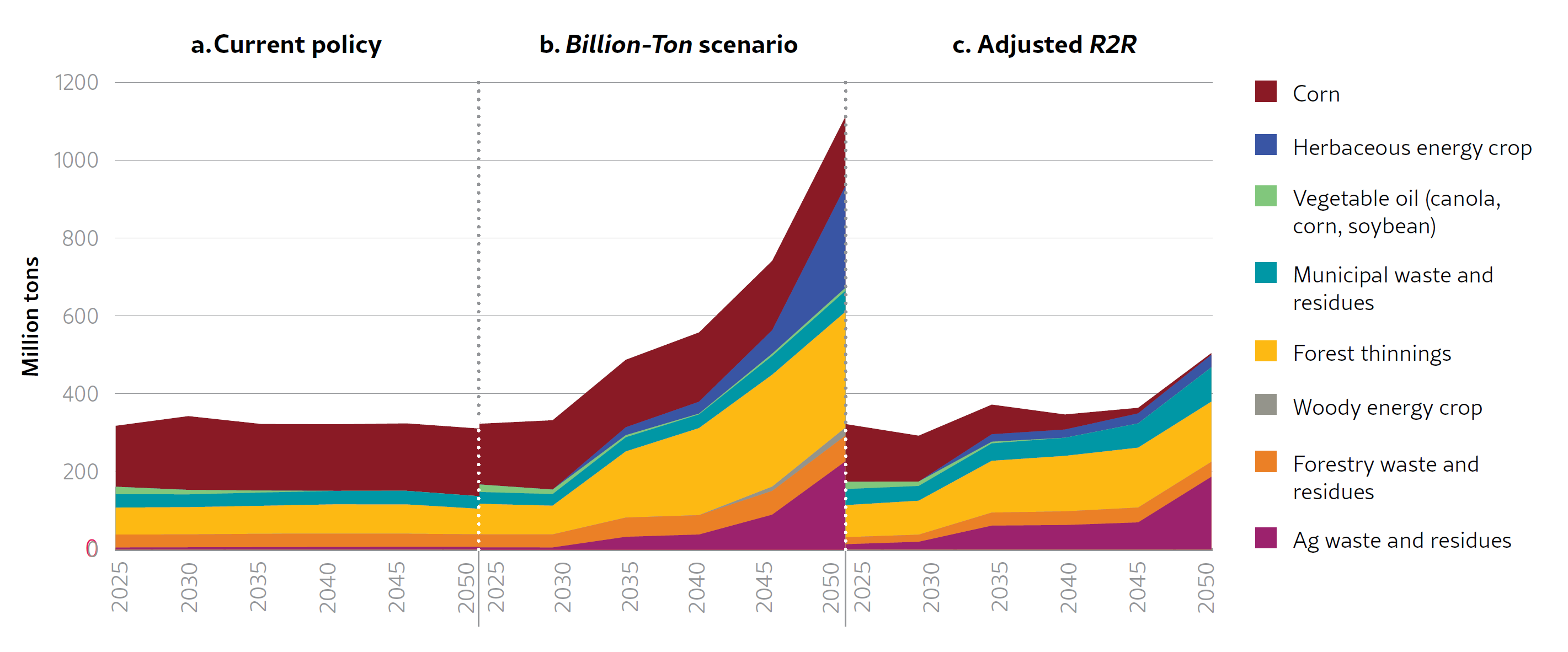
The figure below (figure 3 from the report) compares total biomass use under current policy, a net-zero scenario with the full biomass supply curve from the DOE Billion Ton study (Billion-Ton scenario), and a net-zero scenario with measures in place to ensure sustainable use of biomass (Adjusted R2R). Consistent with similar work, achieving net zero involves an expansion of biomass, but the scale of that expansion and the feedstocks that get used differ significantly depending on the net-zero pathway.
Figure: Biomass Use by Feedstock Category for Primary Scenarios, 2025-2050